OverviewHumans often prefer stability, even if a better life is on the other side of some temporary discomfort. Before we get to that, let’s first visualize “stability” as a locally maximum point on a polynomial function, such that changing your environmental conditions or your behaviors, results in less satisfaction in life: Example: you’re relatively happy with your freelance contractor job. If you took on more work, you might make more money, but you’ll probably get stressed and return to your baseline. It’s the same for if you took on less work, you might get bored and return to your baseline. This is normal: we naturally optimize for general satisfaction. But sometimes in life we fortunately (or unfortunately, depending on your perspective) become aware of a way to live life that’s more satisfying. To get there, however, we have to endure some temporary discomfort: As you slide to the right on this graph (ie: make changes to your environment or behaviors), you undergo the discomfort of change. That discomfort, if it’s too much to handle, can send you back to your original point of comfort/satisfaction: But if you’re able to endure it, then you may reach a new stable point with even more satisfaction: A classic example of this is getting into physical shape. When you haven’t had an exercise routine in a long time, it sucks to start. But once you get into the habit, it’s something you look forward to each day. If you greatly resist change (e.g., you’re a lifelong drug addict, or, you’ve been in an unhappy marriage for 10 years and can’t imagine leaving), that can make it more likely that you'll revert to your old ways, as visualized by a deeper valley of discomfort: Alternatively, if you have a clear vision of the kind of person you want to become, and how to achieve that outcome, then the discomfort can be relatively minimal (but non-zero): The million dollar question is : What determines if a particular change will bring extreme discomfort, or feel relatively easy? It’s two things: “Not every change is an improvement, but every improvement is necessarily a change.” — Eliezer Yudkowsky If your aim is wrong and you’re not making the right changes, and if you’re someone who expects immediate improvements with effort, then one setback can derail all your initial motivation to change. To explain the other reason why we get stuck in life, I’ll next turn to the field of psychotherapy. In author Bruce Tift’s book Already Free: Buddhism Meets Psychotherapy on the Path of Liberation , he explains that: The experiences we have as children [and in adolescence] have a profound impact on the rest of our lives. In response to difficult experiences, we create strategies or behavioral patterns to help us deal with what we experience as threats to our emotional (and sometimes even physical) survival. What we first use for our survival, we later use as a generalized and familiar way of engaging in life. These formulas and strategies are usually very intelligent and appropriate at the time they are created. As a result, they tend to become habitual and persist long after they are needed. Because they are responses to disturbing and even dangerous realities, they’re usually associated with quite a bit of anxiety. We avoid feeling this anxiety by pushing these strategies out of our awareness. They then continue to operate without our conscious participation, potentially for the rest of our lives, unless brought into awareness and challenged once we are adults. The following are some examples of my own hidden (and inadvertently harmful) psychological strategies. By enduring massive amounts of discomfort and change, I managed to reach a higher stable point of satisfaction in life. Difficult Changes I’ve Made OCD OCD feels like you’re trapped and constantly on the verge of sudden annihilation. Getting diagnosed, and then overcoming my OCD , was the hardest thing I’ve done in my life. But it was so goddam worth it. I am much happier, and freer now, to live life to its fullest. Relationships Avoidant attachment affects 20-25% of the population. It limits your ability to create and sustain intimacy/closeness in relationships. Fortunately, you can overcome it with lots of effort, which I wrote about here . Heartbreak Getting my heart broken for the first time , and processing those emotions for months, was overwhelming at first. But then I did some research into the topic, changed my behavior, and finally was able to accept the loss and move on. Easy Changes I’ve Made These examples came about with relatively little discomfort: Weight lifting When I was 19 years old I injured my foot and couldn’t run anymore. Since I already liked exercising, one of my friends suggested I try weight lifting with him. I’ve enjoyed lifting ever since. Finances After graduating college, I read a few personal finance books, set up a budget for myself, and created a spreadsheet to track all my expenses. It didn’t take much effort because I was already a frugal kid growing up and was interested in managing my money well. Selling my TV, video games, and deleting social media I enjoy spending my time by developing new skills or hobbies. So one day I just decided to sell my TV and video games. Additionally, social media felt addicting, so I deleted that, too. How satisfied are you with where you are in life? Let me ask you: have you tied your shoes the same way your entire life? Probably yes. Why bother learning a new way, when what you’re currently doing works? And that’s fine for tying your shoes. But when it comes to other more important topics, we also find equilibrium points and stick to them long past their original use, even when they’re suboptimal and hurting us. For the graphs I created for this essay, one could view them as mountains. Exercise is good for us: go out and climb, explore new things, and enjoy the view when you get to the next highest peak. Discuss
Humans often prefer stability, even if a better life is on the other side of some temporary discomfort.
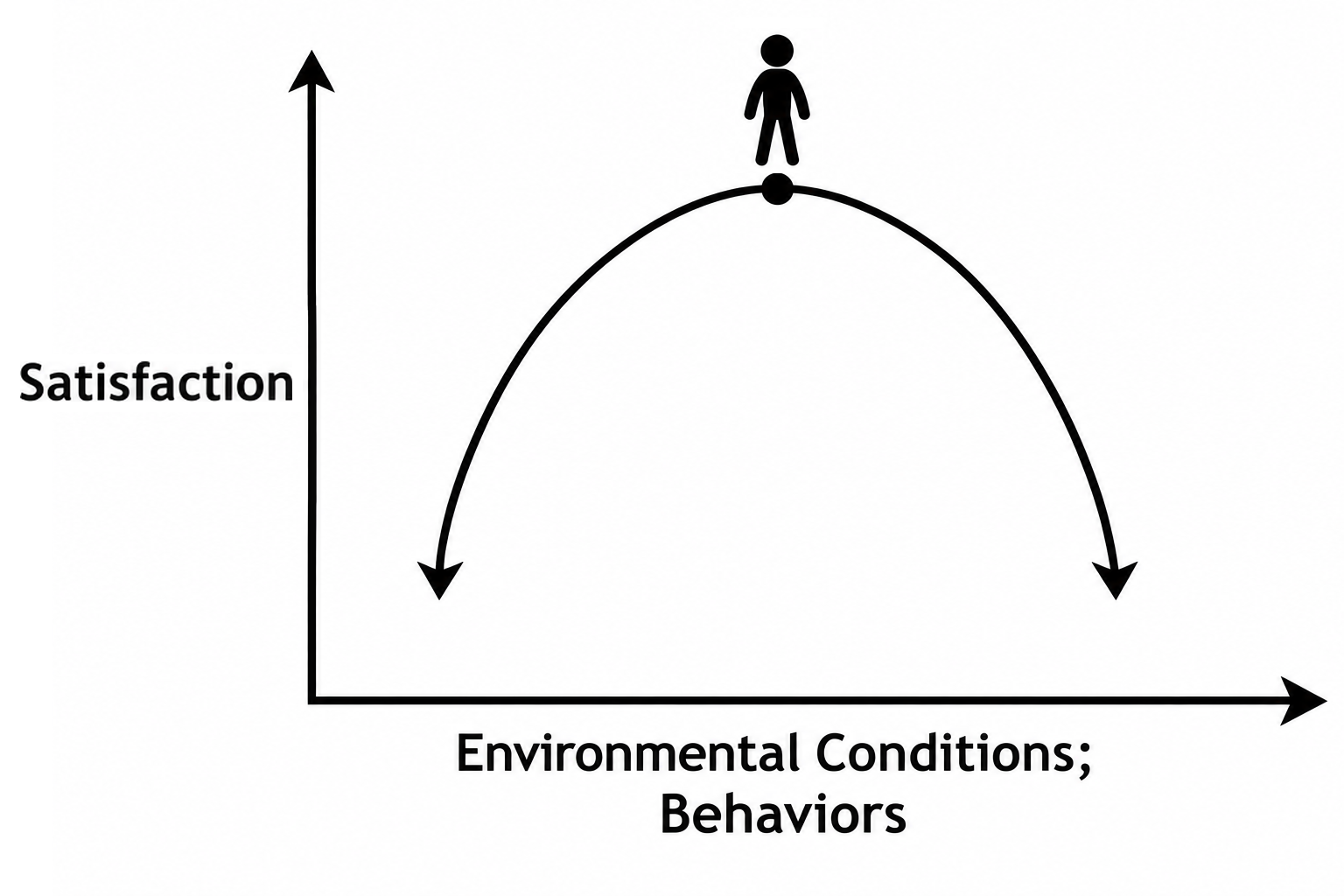
Before we get to that, let’s first visualize “stability” as a locally maximum point on a polynomial function, such that changing your environmental conditions or your behaviors, results in less satisfaction in life:
Example: you’re relatively happy with your freelance contractor job. If you took on more work, you might make more money, but you’ll probably get stressed and return to your baseline. It’s the same for if you took on less work, you might get bored and return to your baseline. This is normal: we naturally optimize for general satisfaction.
But sometimes in life we fortunately (or unfortunately, depending on your perspective) become aware of a way to live life that’s more satisfying. To get there, however, we have to endure some temporary discomfort:
As you slide to the right on this graph (ie: make changes to your environment or behaviors), you undergo the discomfort of change. That discomfort, if it’s too much to handle, can send you back to your original point of comfort/satisfaction:
But if you’re able to endure it, then you may reach a new stable point with even more satisfaction:
A classic example of this is getting into physical shape. When you haven’t had an exercise routine in a long time, it sucks to start. But once you get into the habit, it’s something you look forward to each day.
If you greatly resist change (e.g., you’re a lifelong drug addict, or, you’ve been in an unhappy marriage for 10 years and can’t imagine leaving), that can make it more likely that you'll revert to your old ways, as visualized by a deeper valley of discomfort:
Alternatively, if you have a clear vision of the kind of person you want to become, and how to achieve that outcome, then the discomfort can be relatively minimal (but non-zero):
The million dollar question is : What determines if a particular change will bring extreme discomfort, or feel relatively easy? It’s two things:
In author Bruce Tift’s book Already Free: Buddhism Meets Psychotherapy on the Path of Liberation , he explains that:
The experiences we have as children [and in adolescence] have a profound impact on the rest of our lives. In response to difficult experiences, we create strategies or behavioral patterns to help us deal with what we experience as threats to our emotional (and sometimes even physical) survival. What we first use for our survival, we later use as a generalized and familiar way of engaging in life.
These formulas and strategies are usually very intelligent and appropriate at the time they are created. As a result, they tend to become habitual and persist long after they are needed. Because they are responses to disturbing and even dangerous realities, they’re usually associated with quite a bit of anxiety. We avoid feeling this anxiety by pushing these strategies out of our awareness. They then continue to operate without our conscious participation, potentially for the rest of our lives, unless brought into awareness and challenged once we are adults.
The following are some examples of my own hidden (and inadvertently harmful) psychological strategies. By enduring massive amounts of discomfort and change, I managed to reach a higher stable point of satisfaction in life.
These examples came about with relatively little discomfort:
How satisfied are you with where you are in life?
Let me ask you: have you tied your shoes the same way your entire life? Probably yes. Why bother learning a new way, when what you’re currently doing works? And that’s fine for tying your shoes.
But when it comes to other more important topics, we also find equilibrium points and stick to them long past their original use, even when they’re suboptimal and hurting us.
For the graphs I created for this essay, one could view them as mountains. Exercise is good for us: go out and climb, explore new things, and enjoy the view when you get to the next highest peak.
Loading comments…