The current source text is the original text and can be switched to the Chinese translation.
SaveShare
报道配图 · 来源:LessWrong
Overview
Join us for a San Francisco rationalist dinner in Metreon's food court. First timers welcome. We will talk about AI safety, interesting blog posts, and whatever rationality or related topics that interest people. We will be there at 7pm. Email me at hardy-contort-putt@duck.com if you can't find us. Discuss
Join us for a San Francisco rationalist dinner in Metreon's food court. First timers welcome. We will talk about AI safety, interesting blog posts, and whatever rationality or related topics that interest people.
We will be there at 7pm. Email me at hardy-contort-putt@duck.com if you can't find us.
READ THE ORIGINAL
Read the original for the full context.
The content of this article comes from LessWrong,Copyright belongs to the original author and publisher.
Getting back in the safety field after 4 years feels great. I had a paper on concept distillation where I showed how steering vectors based method did'nt help to debias model since the concepts itself are understood wrongly [ Concept distillation , NeurIPS 2023]. I am so happy to see the steering vectors work picked up in interpretability and was curious to see how methods like ActAdd would work in this debiasing setting?
Introduction If you are reading this post, chances are you believe there is a nonzero probability that humanity will eventually face existential risk from Artificial Intelligence. In fact, there have already been multiple warning shots, with the HuggingFace incident being the most prominent one.
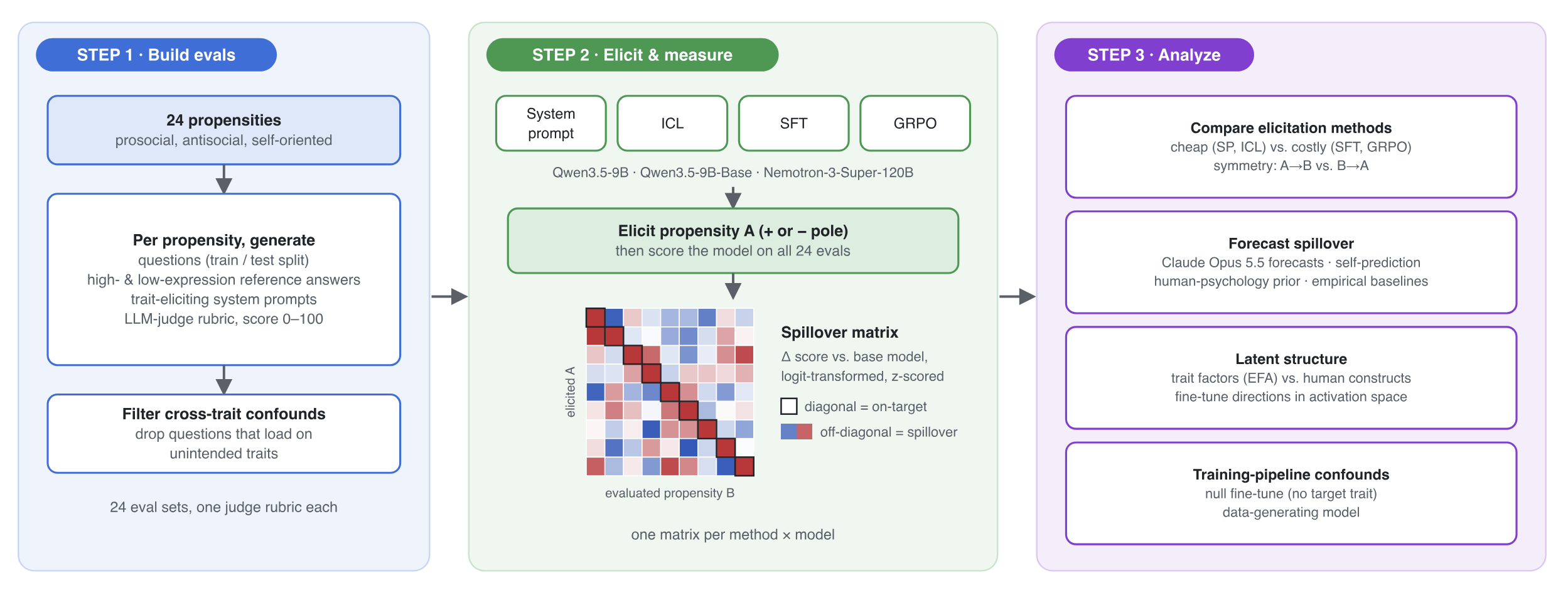
This is a link-post for our new paper " Predicting how propensities generalize out-of-distribution ", which started as a SPAR project. We select 24 propensities, elicit each through 4 different methods, and then test how this spills over to non-targeted traits: How well can we predict spillover? Below is the plot that compares different methods to predict SFT-induced spillover.
Loading comments…