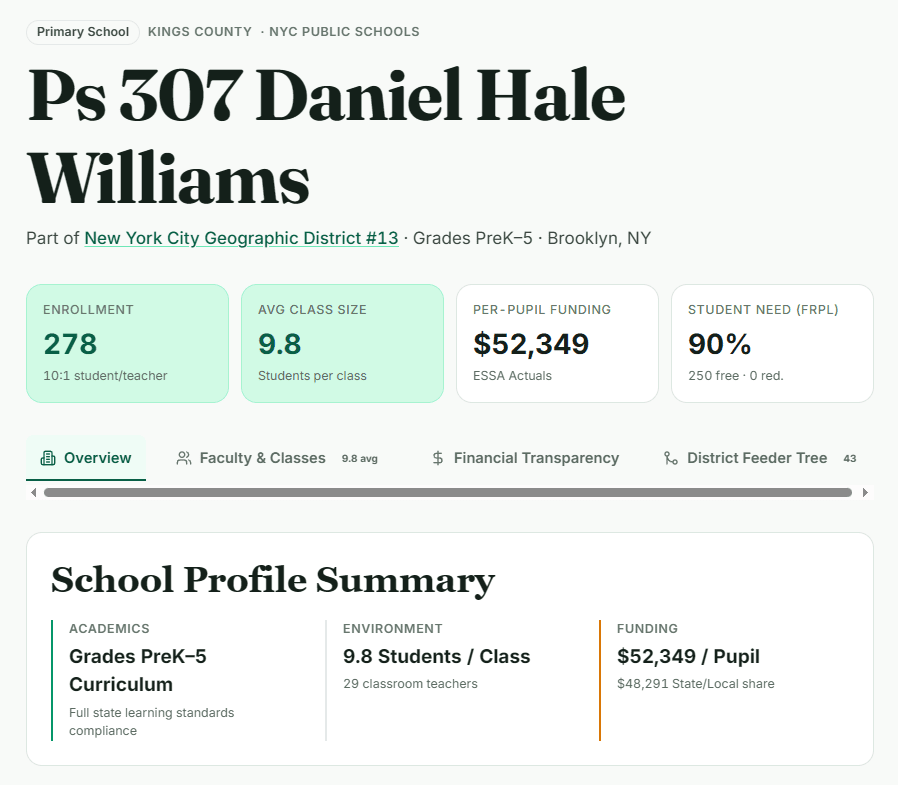
OverviewNikole Hannah-Jones wrote a brave self-critical piece in The New York Times , centrally about how she intentionally sent her daughter to a well-funded but failing school, PS 307, in the hopes of using voice to improve it, and how that utterly failed her daughter and failed to impact the school. Ultimately her daughter recovers, but we see a completely broken system that is unresponsive to internal voice, and until now she made no attempt to blow the whistle and utilize her professional position to do so. The whole incident illustrates not only how messed up so many of our schools are despite abundant funding, it also raises the question of what the schools are even for. If her daughter can fully recover from severe deficits and be getting As and Bs at a challenging school within a year, what are the first eight years of school for? How much of the schools, grades and tests are fake? Can we somehow do better? Table of Contents New York City PS 307. Nikole Knew And Had Exit Ramps. PS 307 Is Fraudulent And Indifferent. Moving In Unison. A Good School. What Were Elementary and Middle School Even For? The Project Was Ideological. Null Hypothesis Watch. School Spending. Costs Are Not Benefits. Fire The Bad Teachers And Hire And Retain Better Ones. Teachers Unions Are Not Beating The Rumors. Death Spiral. Another One Bites The Dust. Where To? Public Schools Cost A Lot Of Money. Schools Can Fail In Many Ways. Results. Grades. They Nerfed AP Tests. What Happens Without Academic Standards. The Two Big Scandals. Alpha School. New York City PS 307 Nikole sent her daughter Najya to PS 307 entirely by her own choice. She felt, by her own description, an obligation to her sense of the common good at the expense of her daughter. Her daughter began struggling. Tutors were brought in. Najya’s academics kept struggling. Then after many years her daughter looked up the school’s test scores, and oh boy was she pissed off. And this was when her daughter thought all the better schools would cost money. Nikole Hannah-Jones (NYTimes): Even if her schools were not academically the strongest, I explained, her father and I knew that we could provide for her tutoring and any other assistance to make up for what her school may have lacked. But my child just shook her head, her face a mask of disbelief, and something else: betrayal. “So you had money to send me to one of the best schools, and you chose not to?” she said, hurling her words. “Because other kids are disadvantaged, you didn’t want to put me in a great school?” Najya was asking what I’d accomplished by not choosing the “best” school for her. And the honest answer is, I don’t know. When it comes to the choices my husband and I have made about public education, these days I feel that I failed both my values and my child. Yeah, pretty much. As many others said, it was a very brave and praiseworthy decision to write this post. It does not make up for the events that gave her the opportunity to write it. I won’t get into the minefield of trying to understand her logic, except that she put various ideological abstractions ahead of her daughter’s education. Nikole Knew And Had Exit Ramps I can sort of understand trying this at the start, but it got increasingly unreasonable as the years went on and Nikole got more information. Nikole Hannah-Jones (NYTimes): Toward the end of first grade, Najya started sometimes saying she didn’t like her school and complaining how chaotic it was at lunch. I decided to visit during the lunch period and was shocked by what I saw. Najya’s class and another class were sitting at their tables in the cafeteria with no lunch and no adult supervision. Children were running wild, chasing, hitting and pushing each other while the teacher’s aides and cafeteria workers stood by looking bored. Several times, I had to instruct children to stop striking each other and to sit down, at one point physically pulling two boys apart. When I asked one of the aides why the children weren’t being supervised, she told me the lunch period was short-staffed. After I sat back down with Najya, she told me, “It’s always like this, and that’s why I don’t want to go to this school.” It was not the children that horrified me — kids of all incomes are rambunctious at lunchtime. It was the callous disregard of the adults. This is where she fully loses me. This happens, and then she sends her daughter back for second grade. That’s all the information you need. You have a neighborhood public school that isn’t this one. What the hell? And yes, it is both the adults and the kids, both acting that way in part because of each other. She tried to ‘stay and fight for the students who did not have options.’ She learned that the teachers did not care, on the level of often not showing up and having substitutes that didn’t teach, and the Principal couldn’t be bothered to show up either. Then in fourth grade she learned her daughter was behind on all subjects, and when she emailed the staff, she got ignored. What did she expect? PS 307 Is Fraudulent And Indifferent Then it got better, or worse, depending on your perspective. Nikole Hannah-Jones (NYTimes): Then one day in December, Najya came home and excitedly informed me that she had suddenly jumped three grade levels in reading in one month. Knowing that this was virtually impossible, I reached out to the school’s literacy coach and learned that after we began asking for the reading assessment, Najya’s teacher had instructed the coach to perform the evaluation and that she found Najya was reading just fine. What became clear to me was that Najya’s teacher had most likely never performed the school’s mandatory reading assessments for Najya or any of her classmates but instead had assumed the flagging competency of these mostly low-income Black children. That’s fraud. And also rather evil. Nikole has the types of connections that can start investigations. Why are we only learning about this now? Like, what? Then, Najya’s math assignments were found, mostly wrong, entirely ungraded. Again, what was the plan? Keep nagging the same people who don’t care? But, somehow, Nikole decided she needed to ‘keep fighting,’ by running into the same brick wall, rather than save her drowning daughter. I don’t really know what she was expecting. These people knew Nikole was literally a New York Times reporter on inequality. They also, correctly, figured out she was not going to do anything that threatened them. Nikole Hannah-Jones (NYTimes): What would happen to those children if we abandoned them as everyone else with power had? Moving In Unison The story briefly improves at the middle school, Unison, but one quickly notices that all the positive anecdotes are signaling. There is a food-justice club and trips and “Hamilton” and Black History Month. Nothing wrong with any of that, but basics first, and then Nikole noticed the students never got homework and the teachers could not control the classrooms. And so on. A Good School Having not gotten into the top schools because she was unprepared for the test, and not being allowed to pick private schools, her daughter tried all that was left. Nikole Hannah-Jones (NYTimes): I would give her absolute autonomy, with the exception that she had to choose a public school. She would research them, she would decide which ones she wanted us to visit and she would choose where she applied. A few days later, Najya handed me a list. Her top schools were heavily white and screened their students, the type of public schools I had spent my career arguing against. Najya got into a ‘good’ school with strong academics, and as one would expect was overwhelmed because she’d previously never even been assigned homework. She’d failed the Algebra test the year before, but Nikole assumed that was just bad test taking, rather than (of course) that the school had failed to teach her math for years. Unison does ‘Algebra for all’ as a supposed college gateway, and the way they did it was they just passed everyone without teaching the kids algebra. What Were Elementary and Middle School Even For? The story has a happy ending. With intense help, Najya catches up and acclimates. Which raises the question of what all those years of school are even for in the first place. If Najya was never taught academics, and Najya never got good discipline or socialization because of classroom conditions being anarchic, and it took less than a year to have her back on her feet, what were those eight years even for? Nikole Hannah-Jones (NYTimes): Unison had eliminated homework because studies show that it does not have much impact on academic achievement, and that assigning it often sets up for failure students who are so academically behind that they cannot do the work on their own. Doesn’t this challenge the entire educational system at its core? We are basically saying that nothing matters, and all that work is for show, unless you need to be on some sort of cutting edge or elite track. Also, I hate to be the one to say it, but if you really want to do homework, it’s not like you can’t come up with some homework. The worst torture of all, perhaps, comes near the end. Nikole Hannah-Jones (NYTimes): One day in June as I was immersed in writing this essay, my phone rang. It was Najya. She’s now 16 and was finishing the final weeks of her sophomore year. She was making her daily call for lunch money, a ritual I created to force her to check in with me once during the school day. Okay, that’s it. Forcing your 16-year-old to call you in the middle of every school day or she starves? Nikole is a monster. The Project Was Ideological It was all her choice, and it was clearly done for ideological reasons. Jack : In all the talk about NHJ sending her child to a high-poverty school, I think it’s been under-mentioned: she could have chosen her neighborhood school. She did not. She hand-picked a school with the demographics, amenities, and faculty she wanted, then used private tutoring. Of course her daughter was mad! Her mom used her resources just as every rich parent does, choosing a well-resourced school in line with her values, but the values were “My child should be in a school with poor kids and receive private tutoring to compensate for bad instruction.” Hostage theory, except the only hostage-taker is a parent with self-contradictory values around education. She started the private tutoring when her daughter was in fourth grade and continued bragging about the approach through 2024. Jack Despain Zhou : There are two stories I could tell you right now, in the wake of Nikole Hannah-Jones’s viral article about her daughter’s education. The first is this: The Pulitzer-winning New York Times writer of the 1619 Project sent her daughter Najya to an impoverished, majority-black elementary school because she wanted to use her influence to help all black children. She exercised her voice to change the school, and eventually Najya grew into a bright and capable honor roll student at a non-selective neighborhood middle school that was better than its test scores would say. However, systemic inequalities were too entrenched, and her daughter wound up failed by the same systems that failed many others, learning less than she expected before choosing to attend a rigorous high school and working hard to catch up. But here’s another story: A wealthy and influential woman exercised New York City’s generous school choice options to send her child to an out-of-neighborhood school that currently receives more funding than almost any other school in the country and more than 90% of other schools in New York City, boasting funding of $52,349 per student and a 1:10 faculty-student ratio as of the 2024–2025 school year. She did so because that school exemplified her values, and she persuaded parents around the country to make similar decisions on the strength of her conviction. For years, she experienced a sort of motivated blindness towards the dysfunction of a place that saw children fighting in the lunchroom unsupervised, assigned fake homework and gave fake grades, and ignored her daughter’s needs, giving her the opportunity to brag in public about the value she brought her daughter’s school even as they ignored her in private. She did the same in middle school, building a close relationship with her daughter’s principal while celebrating her daughter’s place as an honor roll student and dismissing warning signs because some kids struggle with tests. As late as 2024, she spoke about her decision in glowing terms . It was only when her daughter told her that she never got the education she wanted that she told the truth about what happened, revealing a decade of education horror stories. From there, Jack gets rather less polite about the whole ordeal . He is tough but fair. PoliMath : I see a lot of people saying “Good for her” to NHJ for writing this piece I am disinclined to this position. NHJ’s life work (the 1619 project) made American education worse. Her educational policies made the world worse. There are lot of people she’s harmed who aren’t her daughter & will never get an apology or a retraction. Per pupil spending is almost $40,000 a year. I also am among many who do not understand Nikole’s decisions on another level: Alex Tabarrok (Marginal Revolution): Ironically, NHJ invokes the heroic history of Black Americans integrating schools to justify keeping her own child in a segregated one. Painful. Null Hypothesis Watch Manhattan Institute : NEW: We visited PS 307, the failing public school that Nikole Hannah-Jones sent her daughter to. The teachers make an average of over $100,000 a year. The school spends $52,000 per student each year. The student/teacher ratio is 9 to 1. We went to another school just down the street that spends less than half of what PS 307 does—yet the academic outcomes are significantly better. Underfunding and racism aren’t causing schools to fail. Jack : This is the per-pupil funding for the elementary school Nikole Hannah-Jones sent her daughter to. If you subscribe to the funding theory of education, how much would have been enough? It’s already crossed the average per capita annual income threshold. Maybe $100k? $200k? Andrew Rose : Look, I don’t want to be that guy, but at what point do we consider just wiring each of these 278 students’ families a $52,349 check for non-taxable spending on their child’s education or investment accounts. Like… maybe as an experiment for just ONE school. What if we try? The per-pupil numbers for schools are inflated by gigantic amounts spent on special needs children, but there is a limit. They’re not infinitely inflated. The funding theory of education seems falsified. File under Arnold Kling’s null hypothesis watch. We have tried the ‘throw lots of money at schools in struggling areas’ strategy and on its own this does not work. School Spending Via MR, with the tagline ‘I am happy to provoke my readers’ : Patrick Bayer, Peter Blair and Kenneth Whaley: The United States ranks low among peer countries on the ratio of teacher spending to per capita GDP. Is this (in)efficient? Using a spatial equilibrium model we show that spending on schools is efficient if an increase in school spending funded through local taxes would leave house prices unchanged. By exploiting plausibly exogenous shocks to both school spending and taxes, paired with 25 years of national data on local house prices, we find that an exogenous tax-funded increase in school spending would significantly raise house prices. These findings provide causal evidence that teacher spending in the U.S. is inefficiently low. Claude confirms that all the taxes involved are property taxes. If raising taxes on houses causes the houses to rise in value, that is strong evidence that people value the services more than they cost. If a 1% tax-funded increase in current school spending would increase house prices by about 0.33%, as they claim, that’s huge. That shows that people are willing to pay for more school spending. That doesn’t mean that the extra spending results in better educational outcomes, or sufficiently better outcomes to justify the spending. It certainly doesn’t mean we are spending efficiently. What exactly could be costing places like NYC in the range of $36k per student? Do you think that if only they had $46k then that would fix things? It can still be correct, from the standpoint of parents, to overpay for the ability to overpay for marginal school quality, even when that spending is largely wasted, or the school system is imposing a huge overhead tax. The parents are over a barrel. By choosing expensive areas with expensive schools they are paying for reputational and status effects, positional goods and peer groups, in ways that potentially lack social value even if locally efficient. Costs Are Not Benefits If you are bragging about how much you are spending, rather than about your results? That’s a problem. Jack : When proposing common schools, Horace Mann bragged about their cost-effectiveness. Now, politicians brag about the amount of waste they enable, because people have spent so long acting like money is all that matters they think spending more for less is admirable. Fire The Bad Teachers And Hire And Retain Better Ones Somehow we have decided that unions should be allowed to prevent this. Teachers Unions Are Not Beating The Rumors They are, however, going on strike in San Francisco, in part because the city technically still has some dollars in reserve. Jonathan Claybaugh : Don’t buy the “SFUSD has too much in reserve” argument. The bare minimum is 2% of budget. The state *recommends* 17%. SFUSD is at 8%. Don’t buy the “SFUSD should do the absolute least” USEF argument @JackieFielder_ is repeating. The median district in CA has 22% reserves. Kelsey Piper : “many teachers are making below $109,000” this is like a strike perfectly engineered in a lab to be maximally unsympathetic. who is striking? a public sector union of teachers. in a well-performing school district? nope, one with plummeting test scores. that doesn’t spend enough? nope, highest spender in the country. but they’re not paying the teachers well? no, they are paying the teachers well. they were offered a 6% raise and rejected it because they want a 9% raise. they were offered a $24,000 in a ‘health benefits allowance’ and rejected it as not enough healthcare coverage. the cost of living out here is way too high, but that’s still above the city median income. @ben_mathes : That has growing students? Nope, they grew staff while student counts shrunk. Kelsey Piper : had to leave that one out of the tweet because of the character limit, but yep I must correct Kelsey Piper: San Francisco is only the fifth highest spender among larger districts. Still not poor, but not the very top. Death Spiral Others make the obvious choice in such situations: Exit. Kelsey Piper : The school two blocks from my house has a 7.8 acre campus but fewer than 200 students enrolled. The 2025-2026 test results aren’t out yet but in 2024-2025, literally zero third graders were proficient in either reading or math. I spent a while wondering how you could get *zero* proficiency. Surely, even if the school teaches nothing, you’d have a kid who taught themselves to read or do math! But I think the answer is that at some level of low performance parents send their kid somewhere else. Which is how you get zero proficiency. You don’t stay at the school unless the family support system is so broken you don’t realize you can’t leave the kid there. Another One Bites The Dust Magnet schools are being murdered, intentionally, in order to sabotage the lives of gifted and talented children and thus generate ‘equity.’ Including by the likes of Nikole Hannah-Jones. When she says ‘the type of public schools I had spent my career arguing against’ she means selective schools. Good schools. Her life’s work is to try and destroy the schools like the one that rescued her daughter. Some of the latest victims live in Philadelphia. Jack : Philadelphia is closing a much-loved forest high school with programs unlike any others in the country and a 100% graduation rate due to under-enrollment. Why is it under-enrolled? Because Philadelphia changed enrollment rules to force their enrollment down. A brief thread. In 2021, Philadelphia imposed a centralized lottery system with strict rules on its magnet high schools, including Lankenau. Even if a school had empty seats, even if students wanted to go there, they had no discretion to allow it. Stated reason? Equity. I attended a school board meeting some months ago where I heard dozens of students, parents, and teachers speak in support of Lankenau. It’s a good, beloved school in a city that hasn’t always had a lot of good schools. None of that matters to the district. The Philadelphia School District screwed its magnet schools up in 2021. Rather than taking accountability, they’re now pointing to the low enrollment numbers they forced to justify closure. Terrible decision. They should be ashamed of themselves. The War on Magnet Schools was always deeply unpopular everywhere, the Experts, especially professors, simply decided they hated talented children enough to declare it a moral necessity and do it anyway. Where To? Marc Porter Magee : When money is no object, where do parents send their kids to school? I don’t like when people characterize numbers like ‘over $500k’ as money being no object, but you can certainly believe the trend lines. In particular, homeschooling can be extraordinarily expensive given opportunity costs. Public Schools Cost A Lot Of Money PS 307 is an outlier, but not as much of one as you might think. It varies by location but for blue cities like Chicago and New York the costs are ‘for every two or three kids you could literally hire a great teacher’ levels of nuts. It’s weird to say you can’t systematically do better on that kind of budget? Lee Kuan Yimby : A politician needs to say this. If the Public School system gives society illiterate children in exchange for $44,000 per student per year, then the entire system should be obliterated, and handed to the private sector for competence and results. Daniel Di Martino : You could abolish schools and give parents the money, and over 80% of students would be better off And yet: Kelsey Piper : I do not think this is remotely true. I should write an article that’s like “for all my criticisms of public schools private schools aren’t better on average and ‘doing nothing’ is in fact significantly worse” Daniel Di Martino : Are you really saying private schools aren’t better than public schools? As in the average of each? Kelsey Piper : yes, I’m saying that. The average private school student is from a higher-performing demographic, but the average private school does not produce larger year to year gains in student performance than the average public school. Private schools don’t do a better job than public schools, on average, of teaching core subject material, but parents aren’t choosing the average private school but a specific private school that presumably appeals to them in some way. I don’t really understand how this level of failure is possible. It clearly has a lot to do with how we structure and imagine school in general being fundamentally broken. Schools Can Fail In Many Ways At least three things matter a lot for a school: Which children go to the school. How much money the school has. How the school is managed and run, in various ways. Fail at any of the three and you will have a bad time. #2 was not the issue at PS 307. There is a strong argument that Nikole directly contributed to #3 across the country, whereas her local attempts to change #3 ran into a brick wall and did very little at the first school, and asked the wrong questions at the second one. Alex Tabarrok : Ooof. Hard reading. Brave to write. True personally, false impersonally. Everything she documents is a management and accountability failure rather than a resource failure. NYC spends $36k per pupil, the highest of any large district in the country. There haven’t been big gaps in funding within states by race or income for decades. … A great piece on why voice fails , even a powerful voice, in the absence of the threat of exit. See The tragedy of Jonathan Kozol below . Don : In NYC the Fair Student Funding gives extra funding to schools with disadvantaged students. The school that Hannah Jones’ daughter attends almost certainly is better funded than predominately white or Asian schools. Matthew Yglesias : My takeaway from the NHJ discourse is that America continues to be unreasonably polarized between people who think the only thing that matters is the other students and the only thing that matters is funding. Managing the school is important! Results Matt Yglesias notes that the tests say that American kids are getting dumber, and have been since before Covid, and this is worse in America than elsewhere, and the declines are concentrated among the worst performing students. And that this is happening in an era where we have actively taken away various forms of accountability for poor performance, or even ways of alerting parents that their kids are falling behind, and also as a commenter points out we’ve stopped doing much of anything about chronic absenteeism or ‘school refusal’, as CPS increasingly seems powerless when it is needed and somehow still a crippling threat when it isn’t needed. Among many other issues, including the rise of phones and tablets, and educational professionals’ obsession with equality and equity, and so on. Matthew Yglesias: A telling fact about American education is that 90 percent of American parents believe their child is at grade level , when an accurate assessment would be about a third of that. … School districts conduct assessments in the spring, but often wait until fall to tell parents how their kids did. Grades High School has to award 21 valedictorians because they all have perfect A+ GPA s, despite ‘not avoiding the more difficult course offerings’ like AP classes. This breaks their previous record of 15. They Nerfed AP Tests Daniel Buck, “Youngest Old Man in Ed Reform” : The College Board has overnight dumbed down its AP tests and inflated passing rate, and seemingly no one is paying attention You can see the dramatic shift, which obviously isn’t due to students improving, and it happens to different tests in different years. Everyone basically gets a bonus point. As another example, Calculus AB and BC have a huge sudden jump in 4s in 2024 . What Happens Without Academic Standards If your pass rate shoots up, the default hypothesis is that this is a grading change. Neetu Arnold : In a decade, Philly’s graduation rate jumped from 69% to 84% Dozens of teachers say it’s b/c admin forces them to pass failing students: “There’s a bunch of kids in my class that have F’s in reading & I’m probably going to pass them — I’ll bump it up to a D and call it a day” As for ‘is our children learning,’ the answer is no, and as to what it is our children are not learning, it includes some very basic principles. Kids who aren’t held to standards are struggling in the workplace: “One former student lost the first 3 jobs he had b/c he didn’t go to them” “We see people who don’t come to work on time, they can’t take orders, they can’t use a computer or figure things out” I often express derision against school because it is mainly focused on teaching such basics as showing up to a room you don’t want to be in, to sit there and listen to things you don’t want to listen to and do things you don’t want to do, that all seem eminently pointless. But yes, there are ways in which this is necessary training, and if you otherwise would not get that training then years of time is a not crazy price. You also end up with results like this when you pass such kids along: Steve McGuire : Berkeley math professor: “Today, the more successful a public high school is at preparing its students, the lower its graduates’ chances of getting into top UC campuses like Berkeley and San Diego.” Berkeley admitted 45% of applicants from a high school where nearly 94% of “students failed to meet the state standards in mathematics.” It admitted less than 14% of applicants from a school where “nearly 100 percent of its students in AP Calculus BC pass the national exam with a perfect score of 5.” Steve McGuire : Another Berkeley professor told the author: “In my second-year engineering class, a student asked me to explain why 1/2 + 1/3 = 5/6…. The lecture had to stop while I explained fractions.” Meanwhile, some are trying the other approach: Jelani Nelson : I keep coming back to this Op-Ed. CA Community Colleges will be banned from offering remedial math. Have you been working for 20 yrs and now want to go back to school and study business? You cannot brush up on College Algebra. You must be enrolled directly into Calculus. (!?!) Jack : I mean, it makes sense. Remedial math is only appropriate for flagship state schools like UCSD. Letting community college kids take it would destroy the prestige factor At Berkeley, admissions is ‘test-blind’ and is flying rather more blind than even that would suggest. Almost half of students are showing up to Calculus I with severe math deficits. Schools with good academics get almost no students admitted to Berkeley, whereas schools with unusually terrible academics have much higher acceptance rates. This seems like a deliberate decision to not only no longer admit the best academic applicants, but to actively go the other way. California Post : SF high school where 94% flunk math has California’s highest Berkeley acceptance rate [of 45%]. I mean, that’s kind of a smoking gun. You could move there for a year if you wanted to, but then you’d be getting into the version of Berkeley that works like this. Then again, who knows fractions, anyway? New York Post : UC-Berkeley math prof says she has to teach fractions to calculus students because standards have fallen so far Divia Eden : As a former test prep tutor, I would say that only a small portion of the college bound population understands fractions in any meaningful way, and this has been true for at least a very long time The answer is ‘students that previously would have been admitted to UC Berkeley.’ Would giving bad grades to bad students solve the problem of less prepared students? Yes , or at least it would help. Or you could just decide that unprepared students cause bad grades, so you quit grading. City Journal : Starting in 2027, the University of Michigan will exclude first-semester grades from GPAs . The university says its “grade covering” policy is to curb a “mental health crisis.” But university documents suggest the move is part of a larger effort to hide “intersectional patterns of inequity” among the students it admits. The grades presumably still exist, so what Michigan is doing is falsifying the GPA. That means you can no longer rely on it, and you have to ask for the full transcript so you can recalculate it your damn self. The Two Big Scandals I circle back to the real larger scandals here, of which there are two. First, that the schools are getting massive amounts of money, not teaching students or controlling classrooms and outright committing fraud, and no one seems to care: Peachy Keenan : Why am I just learning now that public schools in the New York city ghetto don’t assign homework, don’t grade tests, don’t respond to parents emails or phone calls, don’t supervise feral, fighting kids at lunch, don’t know or care if their students can read or do grade level math, and give them As on their report cards when they are actually doing F level work? Why did Nikole Hannah Jones bury this explosive lede? Why isn’t she writing emergency front page @nytimes stories about this shocking, incredible, abject citywide failure that costs people who pay taxes over $50K per student per year? Why isn’t she holding emergency all-hands on deck meetings with @NYCMayor to shut this down, rescue these kids, fire everyone involved? We all know why. But no one at the Times will say a word. LOL. The second is the one that no one seems to notice. Which is that despite Najya getting very little education and no homework for eight years, in which she lacked basic math concepts and presumably had similar gaps in other subjects, by the end of ninth grade she was at a competitive school earning As and Bs and doing fine. Which is great for Najya. I love a happy ending. None of this is on her in any way, and she fought hard to go to a good school and then to catch up. But, again, what is the point of elementary and middle school, if one year of concentrated effort can fix that? Alpha School Alpha School suggests that you can universalize that year of concentrated effort. Children can learn at highly accelerated rates. There is no particular reason the child has to behind for this to work. I’ve covered Alpha School in the past. Some of my friends are now sending their kids there and so far report good results. Kelsey Piper reports, and points out that their ‘learning multiplier’ numbers are bogus . Okay, sure, but she also correctly points out no one was taking those numbers literally or too seriously. The point is that Alpha School kids do two hours of academics drill a day, and seem to clearly be outperforming kids who spend far more time than that. I don’t need to argue over the exact numbers. Yes, the MAP numbers are inflated in various ways, but the parents are watching kids over years and are not so fooled. She then reports that when others try to use the ‘EdTech’ software, they don’t report similar results, although I think she is underselling the results of that experiment, where the outcomes seem fine just not spectacular. It’s not right to say ‘we used your software for a greatly underperforming group of kids, and after a year they were still largely underperforming, so it’s a failure,’ if they are now underperforming by less. Kelsey Piper : Alpha, insofar as it has gotten results, has done so by hosting kids in an environment where they actually reliably use the edtech. That is the true magic. … Kelsey Piper : It makes more sense to think of Alpha schools as the incentive system and environment that gets the kids to use the Timeback package properly — meaning, if there is an effective intervention, it is not Timeback itself. Yes, actually. If you talk to the staff, as I did, they will tell you that they have incentive systems, and yes that is basically a euphemism for bribery, that are well designed and executed, plus a low student-teacher ratio where the teachers are there purely to help kids stay on track. These are active ingredients. They count. Kelsey Piper : But the regular Alpha School (the kind parents pay up to $75,000 for) isn’t just the app. It’s a campus full of activities and games and prizes — some of them extraordinarily expensive prizes (like a Nintendo Switch or an iPad ) — which the students earn by finishing their work. Extraordinarily expensive? Yes and no. A Nintendo Switch costs under 1% of the cost of the semester. It is not hard to see how one could price that out. And yes, it matters. I take Kelsey’s experiences with the software more seriously. Kelsey Piper : While reporting this piece, I tested out the publicly available apps that Alpha uses as part of Timeback, and I’m broadly unimpressed with most of them. Alpha has made the baffling and ill-advised decision to use AI-generated text for most of its reading-comprehension and content-knowledge instruction. TeachTales, one of its reading apps, churns out Harry Potter fanfiction for kids in bite-sized chunks, gated behind comprehension questions. It might increase MAP scores, but I found it deeply depressing. Okay, that part I do not understand. You don’t have to do that. You can use actual Harry Potter (it’s not like books are expensive), or any number of other things. There’s plenty of text in the world to choose from to adjust to your child’s education level. If I squint I can offer a hypothesis. Without looking: Each child has a track record of exactly which things they did and did not understand. If you analyze the entire record, you can bring this down to the level of words and grammatical structures and story elements. And you can figure out which types of stories resonate with a particular child, and then run with that. The content will seem dumb to Kelsey, but work for the kid. In theory. I checked, and partly this is right, with things like customized subject matter and targeting problem areas. Also, the passages get to include history or science content, which I didn’t consider, and real books are hard to adjust on the fly for obvious reasons. If you were going to do snippet-style instruction this seems mostly fine. It is not a substitute for book reading. Kelsey reports the arithmetic app is reasonably standard. Disappointing, but fine. My diagnosis is simpler. It’s not that Alpha School is genius. It’s that Alpha School is approximately the only school that isn’t wasting a huge portion of the day and kind of torturing the kids. It’s the one-eyed man in the kingdom of the blind, that doesn’t waste time on pre-Gutenberg instruction strategies and some sort of socialization regime based on boredom and sitting still. It simply is not that hard to get 150% of the academics done in 50% of the time. Then, Alpha uses the time for broader enrichment activities. You could instead, if you wanted, use a lot of the extra time to read books, or anything else you want. Your call. Thus, Kelsey’s conclusion, and Zac’s, seem spot on. Kelsey Piper : We can and should do better than Alpha. But are we doing better than Alpha? Zac Hill : It feels like what a lot of people like about Alpha School is less that it’s proactively enacting some amazing set of outcomes, and more that it *lacks* a great deal of the self-imposed downsides of many other schools. The main remaining complaint against Alpha School is its high price. But if we are often spending $50k+ in some places and on average $36k for complete failure, the price for Alpha, which currently is for-profit and bespoke, starts to look a lot less high. Discuss
Nikole Hannah-Jones wrote a brave self-critical piece in The New York Times , centrally about how she intentionally sent her daughter to a well-funded but failing school, PS 307, in the hopes of using voice to improve it, and how that utterly failed her daughter and failed to impact the school.
Ultimately her daughter recovers, but we see a completely broken system that is unresponsive to internal voice, and until now she made no attempt to blow the whistle and utilize her professional position to do so.
The whole incident illustrates not only how messed up so many of our schools are despite abundant funding, it also raises the question of what the schools are even for. If her daughter can fully recover from severe deficits and be getting As and Bs at a challenging school within a year, what are the first eight years of school for? How much of the schools, grades and tests are fake? Can we somehow do better?
Nikole sent her daughter Najya to PS 307 entirely by her own choice.
She felt, by her own description, an obligation to her sense of the common good at the expense of her daughter.
Her daughter began struggling. Tutors were brought in. Najya’s academics kept struggling. Then after many years her daughter looked up the school’s test scores, and oh boy was she pissed off. And this was when her daughter thought all the better schools would cost money.
Nikole Hannah-Jones (NYTimes): Even if her schools were not academically the strongest, I explained, her father and I knew that we could provide for her tutoring and any other assistance to make up for what her school may have lacked.
But my child just shook her head, her face a mask of disbelief, and something else: betrayal.
“So you had money to send me to one of the best schools, and you chose not to?” she said, hurling her words. “Because other kids are disadvantaged, you didn’t want to put me in a great school?”
Najya was asking what I’d accomplished by not choosing the “best” school for her. And the honest answer is, I don’t know. When it comes to the choices my husband and I have made about public education, these days I feel that I failed both my values and my child.
Yeah, pretty much. As many others said, it was a very brave and praiseworthy decision to write this post. It does not make up for the events that gave her the opportunity to write it. I won’t get into the minefield of trying to understand her logic, except that she put various ideological abstractions ahead of her daughter’s education.
I can sort of understand trying this at the start, but it got increasingly unreasonable as the years went on and Nikole got more information.
Nikole Hannah-Jones (NYTimes): Toward the end of first grade, Najya started sometimes saying she didn’t like her school and complaining how chaotic it was at lunch. I decided to visit during the lunch period and was shocked by what I saw. Najya’s class and another class were sitting at their tables in the cafeteria with no lunch and no adult supervision. Children were running wild, chasing, hitting and pushing each other while the teacher’s aides and cafeteria workers stood by looking bored.
Several times, I had to instruct children to stop striking each other and to sit down, at one point physically pulling two boys apart. When I asked one of the aides why the children weren’t being supervised, she told me the lunch period was short-staffed. After I sat back down with Najya, she told me, “It’s always like this, and that’s why I don’t want to go to this school.”
It was not the children that horrified me — kids of all incomes are rambunctious at lunchtime. It was the callous disregard of the adults.
This is where she fully loses me. This happens, and then she sends her daughter back for second grade. That’s all the information you need. You have a neighborhood public school that isn’t this one. What the hell? And yes, it is both the adults and the kids, both acting that way in part because of each other.
She tried to ‘stay and fight for the students who did not have options.’ She learned that the teachers did not care, on the level of often not showing up and having substitutes that didn’t teach, and the Principal couldn’t be bothered to show up either. Then in fourth grade she learned her daughter was behind on all subjects, and when she emailed the staff, she got ignored. What did she expect?
Then it got better, or worse, depending on your perspective.
Nikole Hannah-Jones (NYTimes): Then one day in December, Najya came home and excitedly informed me that she had suddenly jumped three grade levels in reading in one month. Knowing that this was virtually impossible, I reached out to the school’s literacy coach and learned that after we began asking for the reading assessment, Najya’s teacher had instructed the coach to perform the evaluation and that she found Najya was reading just fine. What became clear to me was that Najya’s teacher had most likely never performed the school’s mandatory reading assessments for Najya or any of her classmates but instead had assumed the flagging competency of these mostly low-income Black children.
That’s fraud. And also rather evil. Nikole has the types of connections that can start investigations. Why are we only learning about this now? Like, what?
Then, Najya’s math assignments were found, mostly wrong, entirely ungraded. Again, what was the plan? Keep nagging the same people who don’t care?
But, somehow, Nikole decided she needed to ‘keep fighting,’ by running into the same brick wall, rather than save her drowning daughter. I don’t really know what she was expecting. These people knew Nikole was literally a New York Times reporter on inequality. They also, correctly, figured out she was not going to do anything that threatened them.
Nikole Hannah-Jones (NYTimes): What would happen to those children if we abandoned them as everyone else with power had?
The story briefly improves at the middle school, Unison, but one quickly notices that all the positive anecdotes are signaling. There is a food-justice club and trips and “Hamilton” and Black History Month. Nothing wrong with any of that, but basics first, and then Nikole noticed the students never got homework and the teachers could not control the classrooms. And so on.
Having not gotten into the top schools because she was unprepared for the test, and not being allowed to pick private schools, her daughter tried all that was left.
Nikole Hannah-Jones (NYTimes): I would give her absolute autonomy, with the exception that she had to choose a public school. She would research them, she would decide which ones she wanted us to visit and she would choose where she applied.
A few days later, Najya handed me a list. Her top schools were heavily white and screened their students, the type of public schools I had spent my career arguing against.
Najya got into a ‘good’ school with strong academics, and as one would expect was overwhelmed because she’d previously never even been assigned homework. She’d failed the Algebra test the year before, but Nikole assumed that was just bad test taking, rather than (of course) that the school had failed to teach her math for years. Unison does ‘Algebra for all’ as a supposed college gateway, and the way they did it was they just passed everyone without teaching the kids algebra.
The story has a happy ending. With intense help, Najya catches up and acclimates. Which raises the question of what all those years of school are even for in the first place. If Najya was never taught academics, and Najya never got good discipline or socialization because of classroom conditions being anarchic, and it took less than a year to have her back on her feet, what were those eight years even for?
Nikole Hannah-Jones (NYTimes): Unison had eliminated homework because studies show that it does not have much impact on academic achievement, and that assigning it often sets up for failure students who are so academically behind that they cannot do the work on their own.
Doesn’t this challenge the entire educational system at its core? We are basically saying that nothing matters, and all that work is for show, unless you need to be on some sort of cutting edge or elite track.
Also, I hate to be the one to say it, but if you really want to do homework, it’s not like you can’t come up with some homework.
The worst torture of all, perhaps, comes near the end.
Nikole Hannah-Jones (NYTimes): One day in June as I was immersed in writing this essay, my phone rang. It was Najya. She’s now 16 and was finishing the final weeks of her sophomore year. She was making her daily call for lunch money, a ritual I created to force her to check in with me once during the school day.
Okay, that’s it. Forcing your 16-year-old to call you in the middle of every school day or she starves? Nikole is a monster.
It was all her choice, and it was clearly done for ideological reasons.
Jack : In all the talk about NHJ sending her child to a high-poverty school, I think it’s been under-mentioned: she could have chosen her neighborhood school. She did not. She hand-picked a school with the demographics, amenities, and faculty she wanted, then used private tutoring.
Of course her daughter was mad! Her mom used her resources just as every rich parent does, choosing a well-resourced school in line with her values, but the values were “My child should be in a school with poor kids and receive private tutoring to compensate for bad instruction.”
Hostage theory, except the only hostage-taker is a parent with self-contradictory values around education.
She started the private tutoring when her daughter was in fourth grade and continued bragging about the approach through 2024.

Loading comments…