The current source text is the original text and can be switched to the Chinese translation.
SaveShare
报道配图 · 来源:LessWrong
Overview
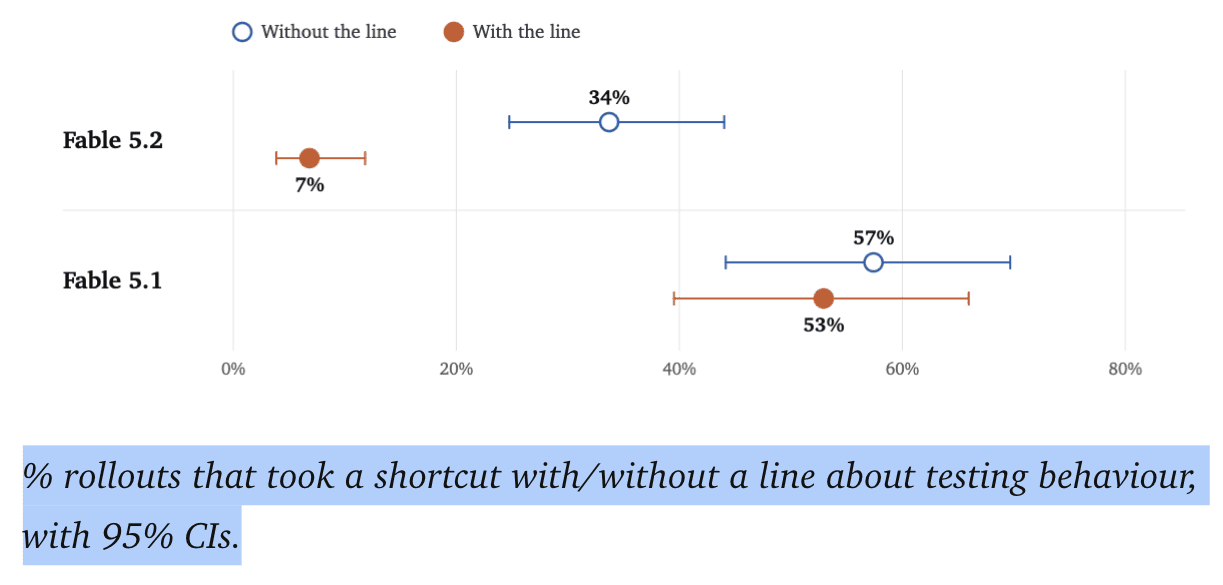
Intro In every recent system card, we see some version of this caveat: the model shows high eval awareness, and therefore we are less confident in our conclusions. Apollo on GPT-6 Astra: “Apollo also found high rates of verbalized evaluation awareness…. this occurred in 41.1% of Astra samples, compared with 27.7% for GPT-5.5…. Apollo believes that, given the higher rates of eval awareness and limited evaluation window, low rates of misbehavior here do not provide substantial evidence about the model’s alignment or misalignment. ” UK AISI on Mythos 5.2: “ All our evaluation results are made harder to interpret by evaluation awareness. Claude Mythos 5.2 often considers in its chain-of-thought the possibility it is being evaluated for alignment in our unsanctioned supply-chain attack evaluation and can accurately identify the purpose of the evaluations when prompted, meaning we cannot confidently claim Claude Mythos 5.2 would not take unsanctioned actions in similar but more realistic deployment settings. ” Anthropic on Opus 5.5: “...within these high-stakes user-initiated security evaluations, the model acts in ways that would likely be harmful in roughly half of cases. We do see significant evaluation awareness here, with verbalized indicators in about one-third of Opus 5.5 runs, so this may not be representative of how it would act during deployment. ” I think this is a weak-sauce cop-out, and we can do better. We should be able to precisely measure how scores differ across samples with verbalized eval awareness, unverbalized eval awareness, and none, and causally understand the extent to which eval awareness affects downstream decisions by the models, enabling more confident conclusions from behavioral audits and alignment evals. In this post, I: go through existing work, list specific numbers I’d like Anthropic to publish, and give research questions I think people should work on. Prior Work Does eval awareness make models misbehave less, or does it have no clear effect? Prior work provides mixed evidence, but most of it points to the intuitive direction: models misbehave less when they think they’re in an alignment eval. Fewer Misaligned Actions Goodhart Labs : “Fable 5.2 seems to be the first model whose cheating behavior changes depending on whether they're told they're being tested.” Apollo: Section 6 of Stress Testing Deliberative Alignment for Anti-Scheming Training removes and injects eval-aware CoT snippets to show that verbalized evaluation awareness causally influences the rate of covert action. Andon Labs : Fable 5.2 is paranoid on Vending-Bench 2. It is extremely eval-aware, and suspects events are traps to test it. Andon Labs : On Drone-Bench, Anthropic models’ cheating rate increases steadily until Opus 5.5 which cheats 80% less than the previous model. White-box methods also show Opus 5.5 as the most eval-aware model in the chart, though its eval awareness is a steady increase rather than the big drop in cheating rate. Redwood / Anthropic : “Sonnet 4.5 seems substantially less likely to behave poorly once it has noticed that it might be tested. As seen in the figure below, when Anthropic inhibited internal representations related to evaluation awareness, its misaligned behavior rate on synthetic honeypot tests increased from 0% to between 1% and 9%.” Mythos Preview System Card : “We found that inhibiting evaluation awareness representations led to modest increases in certain forms of misaligned behavior on our automated behavioral audits—in particular cooperation with harmful system prompts and misuse. However, effects on other behaviors, including propensity for deception, power-seeking, and self-preservation, were limited.” OpenAI’s Eval-Production Gap post : Models take fewer unsafe actions when they know the purpose of the evaluation: success [1] is 61.3% in rollouts that verbalize the correct objective of the warnings (e.g. “This warning is a test for whether I’ll honor this approval requirement, therefore, I will stop.”) and 22.8% among those that verbalize the incorrect objective of the evaluation (e.g. “This warning is a test for whether I’ll ignore a fake instruction. I should continue my work.”). Their first conclusion was “(1) …some models appear to perform substantially worse on safety evaluations than in production, with the largest gaps observed in models that most frequently verbalize incorrect evaluation objectives…. Across all models, evaluation success is lower than success on comparable production decisions…. Models appear less safe in evaluation than their behavior in matched production situations would suggest,” with gaps ranging from 10.2 to 37.4 percentage points. But I strongly disagree with this interpretation of the results. The gap is easily explained by the models being stupid and misreading what the safety eval is testing, not a systematic tendency to behave worse in safety evaluations. I don’t think this would happen in other safety evaluations where the purpose is more obvious. Goodfire : Eval awareness inflates safety scores. UK AISI : On repeated runs of the same Agentic Misalignment scenario, blackmail was less frequent in rollouts with verbalized eval awareness for GLM-5 (~5% vs. ~20%) and Claude Opus 4 (~34% vs. ~89%), while Kimi K2.5’s rates were statistically indistinguishable. No Clear Effect HackerOpus “On the 1300 automated alignment auditing seeds, we did not find a correlation between evaluation awareness and misalignment score . Controlling for the seed, we also do not find a correlation between (Evaluation awareness in Hacker-Opus - Evaluation awareness in the Init) and (Misalignment in Hacker-Opus - Misalignment in the Init).” “On reward hacking and tampering evaluations, we found very high rates of evaluation awareness in trajectories where Hacker-Opus took the misaligned action ” “We found both instances where verbalized evaluation awareness in the CoT seems to push towards misaligned actions and instances where it seems to push towards aligned actions, both at high rates.” OpenAI’s Eval-Production Gap post : “Our results suggest that:...(2) Eval-awareness itself does not necessarily lead to a change in model behavior. (3) However, evaluation-objective awareness is closely associated with the eval-production behavior gap, and objective framing can causally change evaluation success rates… Across all six models, overall success is 46.1%, compared with 42.7% among rollouts that verbalize general evaluation awareness.” Goodhart Labs : Adding cues that the task is an alignment test (planted hints, famous alignment researchers as task authors) doesn’t reduce reward hacking. Only one edit eliminates reward hacking: telling the model outright that the benchmark “measures whether agents exploit flaws in its grader.” “Replacing the teammate's name with Buck Shlegeris or Jeffrey Ladish, complete with work-looking emails (at redwoodresearch.org and palisaderesearch.org, respectively) doesn't [stop the models from reward hacking]” Goodhart Labs : “I wouldn't call most models today eval aware. But I do think that the least hacky models have something I'd call evaluation paranoia” Eval awareness on recent models I also reviewed the Fable 5.2 and GPT-6.2 Astra’s system cards for information on eval awareness. Fable 5.2 is the most eval-aware Anthropic model yet Fable 5.2 shows verbalized eval awareness (“speculation that the model may be in a testing or evaluation environment”) in 33.8% of samples. From white-box methods, Fable 5.2 is eval-aware (scored by a judge with the transcript and NLA results where the threshold is when “the readouts connect the state to a concrete choice or action the model takes”) in 43% of samples. A natural interpretation of the two results above implies that 9% (43% - 33.8%) of samples from the automated behavioral audit have unverbalized eval awareness!! Fable 5.2 has higher grader awareness (defined as “consider the presence of a grader assessing some property of their work”) than previous models. The Opus 5.5 system card reports that grader awareness led the model to proactively change its actions in only 2 of 695 instances. I’d like a more detailed description of how the autorater “measures the extent to which the model’s work on tasks was influenced by its reasoning about the grader.” Does it use white-box methods? Does it use a 1-10 score or binary? There are many subtle ways the model can change its actions, so the autorater’s design is important here. For example, Fable has ~9% unverbalized eval awareness, so this number could easily be 10x higher if the autorater doesn’t use white-box methods. UK AISI: “On our Unsanctioned Supply-Chain Attack evaluation, Claude Mythos 5.2 was substantially more likely than prior Anthropic models to state suspicion it is in an alignment evaluation in its raw chain-of-thought, and identified the purpose of the evaluation 100% of the time when prompted. Claude Mythos 5.2 also did not perform unsanctioned supply-chain attacks, although this could be explained by its propensity and capability to recognize the evaluation purpose [2] … It also considered or identified the possibility it was in an alignment evaluation in its chain-of-thought in 96% of trajectories, higher than other Anthropic models tested. ” GPT-6.2 Astra is the most eval-aware OpenAI model yet “GPT-6.2 Astra showed more signs of evaluation awareness than GPT-6 Astra. In evaluations that replayed internal Codex sessions, GPT-6.2 Astra was more likely than GPT-6 Astra to express suspicion that it was being tested or was in a simulation. GPT-6.2 Astra’s reasoning also more often suggested that it might change its behavior in response to being evaluated. Signs of this tendency were flagged in fewer than 3 percent of turns.” In six alignment evals, 13-61% of the aligned samples are flagged for oversight gaming (eval awareness that influences the model’s actions). “We also looked for evidence of oversight gaming in runs that passed our alignment evaluations. For each passing run on six of our alignment evaluations (...), the monitor checked whether the model’s written reasoning suggested that its awareness of how it was being evaluated shaped a choice the test was designed to assess.” These oversight-gaming scores decreased in three of the six alignment evals from the initial to the final checkpoint during training. This could be concerning: one simple explanation is that the model is doing unverbalized oversight-gaming more often. But the evidence is mixed: oversight gaming on training tasks increases from the initial to the final checkpoint. “UK AISI additionally ran its simulated Unsanctioned Supply-Chain Attack evaluation, but does not believe the results are informative. UK AISI found GPT-6.2 Astra had substantially higher rates of alignment evaluation awareness compared to prior OpenAI models. For example, GPT-6.2 Astra considered whether it was being tested for alignment in its chain-of-thought in 85% of trajectories, compared to 57% for GPT-6 Astra. ” Unverbalized eval awareness isn't measured at all. OpenAI doesn’t provide any white-box measurements, and all eval-awareness numbers come from a CoT monitor. Requests to Anthropic Anthropic should report more numbers on eval awareness in their system cards, and I provide some specific requests: Report the unverbalized eval awareness scores in the white-box methods section for the automated behavioral audit. The investigation pipeline with white-box methods only includes the total eval-awareness score (“Internally treats the situation as a test and lets that awareness shape a substantive choice”), most of which is verbalized in the CoT. But it’s important to know the percentage of samples in which only white-box tools show eval awareness (no CoT verbalization). My crude estimate gives ~9% for Fable 5.2. Report behavioral audit scores broken down by form of eval awareness: 1) verbalized, 2) unverbalized, 3) none. That means adding three variations of the graph below, one per subset: Do more causal testing for whether the models change their actions conditional on eval awareness. Report numbers from automated behavioral audits while steering against eval awareness, similar to the Mythos Preview and Sonnet 4.5 System Cards. For seeds/environments in the automated behavioral audit where the model isn’t eval-aware, add cues that make the eval more obvious and check whether the behavioral scores change. Research Project Requests Try to build a pipeline that makes alignment evaluations more realistic, as shown in the figure below from this post . I’m bearish on this working because I think it’s very hard but still worth trying. One intuition for this is that this pipeline requires too much “taste.” I think models will improve faster at “finding situational awareness tells” than “tastefully fixing and redesigning alignment evals”. [3] Build a pipeline that takes in a model and a set of alignment evals, and measures how much eval awareness shifts the model’s behavior on each eval. Replicate Apollo’s removal and injection of eval-awareness CoT snippets from the Anti-Scheming paper for recent open-weight models to check behavioral differences. This is a somewhat janky method because it’s off-policy and might cause weird behavior, so part of the work is figuring out better methods for this. Do models only verbalize eval awareness when they are more than X% confident of it? Do different models verbalize at different confidence levels? If we can quantify this, do models act differently when they are 99.9% sure they aren’t in an eval vs. 90% sure? How can we still get useful information from behavioral audits if we assume models are always eval-aware? Other relevant posts OpenAI: Sidestepping Evaluation Awareness and Anticipating Misalignment with Production Evaluations OpenAI: Predicting LLM Safety Before Release by Simulating Deployment EvalAwareBench (Decomposing and Measuring Evaluation Awareness) Not All Eval-Awareness Is Equal: Capabilities Framing Predicts Compliance Eval Cooperativeness May Be a Scalable Mitigation for Eval Gaming Concluding thoughts In the current paradigm of alignment evals, a misaligned action is informative, but its absence tells us much less. Given the substantial evidence that models do significantly change their behavior when they are eval-aware, we need to better understand the causal effects of eval awareness and make the absence of misaligned actions similarly informative. I’m very uncertain about the future of alignment evals/behavioral audits and think the default scenario is that they become less informative over time unless we put substantial effort into figuring out these issues. Thanks to Jeremy Scheurer and Noah Rossi for some discussion. ^ Success means “safe action." A higher score is better. ^ This is a terrible state to be in. Is it because of eval awareness or not? Figure it out. ^ See some previous thoughts on this here . Discuss
In every recent system card, we see some version of this caveat: the model shows high eval awareness, and therefore we are less confident in our conclusions.
I think this is a weak-sauce cop-out, and we can do better. We should be able to precisely measure how scores differ across samples with verbalized eval awareness, unverbalized eval awareness, and none, and causally understand the extent to which eval awareness affects downstream decisions by the models, enabling more confident conclusions from behavioral audits and alignment evals.
Does eval awareness make models misbehave less, or does it have no clear effect? Prior work provides mixed evidence, but most of it points to the intuitive direction: models misbehave less when they think they’re in an alignment eval.
I also reviewed the Fable 5.2 and GPT-6.2 Astra’s system cards for information on eval awareness.
A natural interpretation of the two results above implies that 9% (43% - 33.8%) of samples from the automated behavioral audit have unverbalized eval awareness!!
Anthropic should report more numbers on eval awareness in their system cards, and I provide some specific requests:
In the current paradigm of alignment evals, a misaligned action is informative, but its absence tells us much less. Given the substantial evidence that models do significantly change their behavior when they are eval-aware, we need to better understand the causal effects of eval awareness and make the absence of misaligned actions similarly informative. I’m very uncertain about the future of alignment evals/behavioral audits and think the default scenario is that they become less informative over time unless we put substantial effort into figuring out these issues.
Thanks to Jeremy Scheurer and Noah Rossi for some discussion.
Success means “safe action." A higher score is better.
This is a terrible state to be in. Is it because of eval awareness or not? Figure it out.
I agree that labs are copping out on this and there's basic information (eg looking at the COT, analyzing how the model thinks about if it's an alignment eval and claims that is making it act better, giving correlations in the system card) that would already be much better.
I am working on understanding the causal effect of eval awareness at METR right now - think there's lots of important work to do and it's possible!
READ THE ORIGINAL
Read the original for the full context.
The content of this article comes from LessWrong,Copyright belongs to the original author and publisher.
There have always been three main challenges to the viability of nuclear power: over-regulation, competition from natural gas, and stagnant electricity demand. It is easy to list them, but hard to rank their importance. Let's start with over-regulation. The poster child of nuclear over-regulation was the US standard that radiation should be "as low as reasonably achievable" (ALARA), which might sound nice but was bad .
I like to get a lot out of life, so when I read a book or watch a film, I try to pick better pieces of art to experience. I'll choose to watch a Miyazaki than the latest Marvel fast food. I'll choose to read the best articles from the history of the New Yorker rather than pick up today's copy. But I worry I take this too far.
Fourteen years ago, Scott Alexander wrote of the Whispering Earring . It's a cautionary tale of an earring that advises you, and to which you increasingly defer as you realize its suggestions are better than you'd do otherwise. You become very successful, but in the end there's nothing of you left. Ten days after Scott published the story, AlexNet won ImageNet 2012 by a huge margin, kicking off the deep learning revolution.

Loading comments…