CoreWeave had a bad week last week. Its bonds slipped into distressed territory by a common definition - when investors demand 1,000 basis points more in yield than they'd get from government bonds. Last Tuesday Chamath "SPAC King" Palihapitiya noticed the distressed debt, and also asked whether the AI buildout was a private credit bubble. […]
Generative AI models run on powerful chips known as GPUs, which depend on stacks of specialized memory chips packaged with the processor. To meet growing demand for memory, Samsung is building a massive new semiconductor manufacturing complex in Pyeongtaek, South Korea. Three fabs already operate around the clock, and a fourth is coming online. Construction…
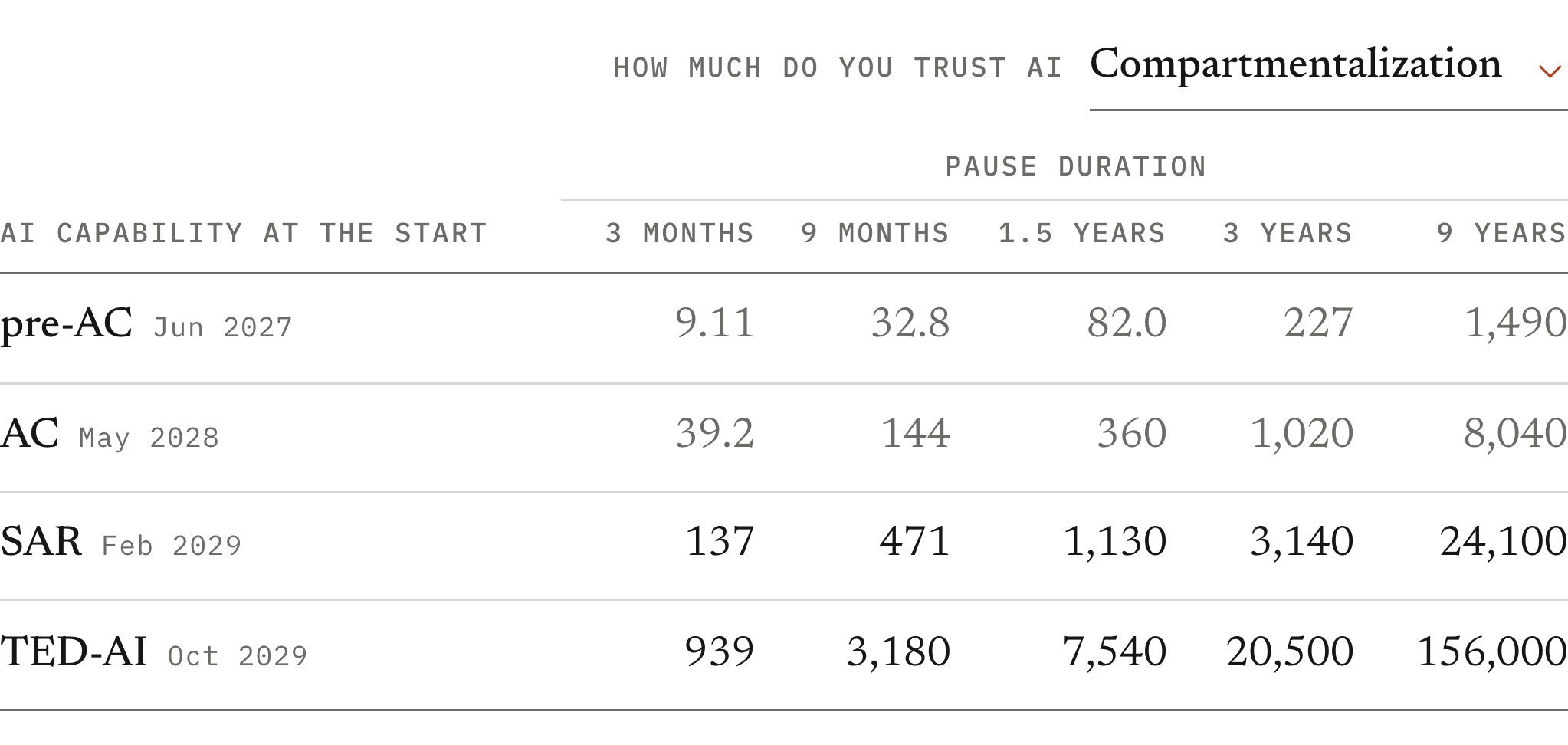
A three-year AI pause could buy 1000 years' worth of AI safety work. See: https://1000yearsofaisafety.com How much AI safety work a pause produces, in years of the whole 2025 AI safety field's work . The government bans new large training runs and gets the top three US labs to redirect their GPUs and researchers to safety research. We developed a model of an AI pause that estimates how much AI safety research it produces.
Graham Greene described G. H. Hardy’s 1940 book, A Mathematician’s Apology , as the best account of what it is like to be a creative artist. Hardy had many friends, wide-ranging interests that included the game of cricket, and empathy for the less well-off. But it was his creative work in pure mathematics that gave Hardy “the one great permanent happiness of my life.” “Mathematics,” writes C. P.
Mayor Zohran Mamdani said Monday night that New Yorkers must resist the narrative that an AI takeover is inevitable and demand regulations that protect the public and put power back in their hands.
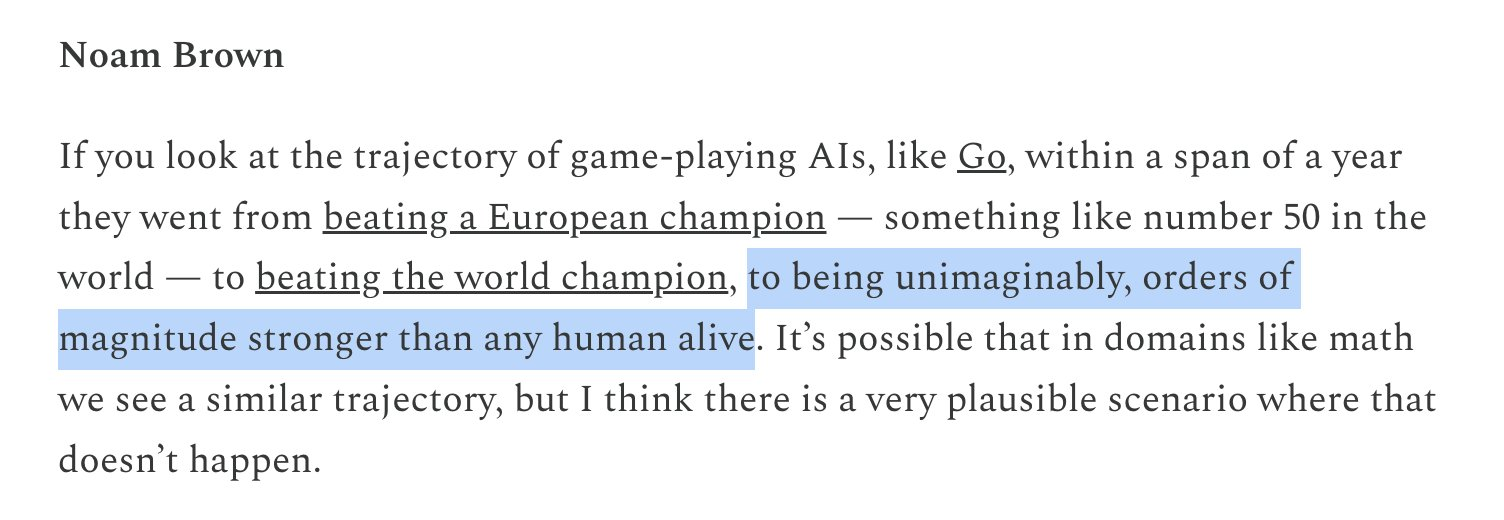
In July 2026, Korean Go player Shin Jin-seo defeated KataGo 2-1 , with only [1] a 2-stone handicap (favoring Shin). I thought this was very surprising, and posted on LessWrong and Twitter asking how to interpret this. I didn’t get any entirely satisfactory answer, so I decided to spend ~one day looking into it and writing up my understanding.
I believe the flow of interesting things to people who would be interested in them is not currently as effective as it could be. I also believe (a) that such a system could be built and (b) it would have important implications for society. I will now attempt to describe what such a system could look like, and some of the ways it could impact society. Think of such a system as containing four layers.
I am Austrian and wrote this in German. The English is a literal machine translation, not rewritten. Everywhere now, catastrophic harm to humanity is being discussed, and various scenarios. But the other percentages are not mapped in detail by outcome, the way it is done with nuclear scenarios, where people look at this more closely. That is possible. People do not go deeper, they do not use this method.
Introduction I recently watched the video "'AI Existential Risk' Was Invented to Distract Us" by Adam Conover of Adam Ruins Everything where he expressed his views on why he believes the claim of the extinction threat posed by AI is being used as a diversion from other harms caused by AI. I’ve seen this narrative being tossed around a bit so I figured I’d take the opportunity to investigate some of the claims being made and offer counterpoints.
The idea of embedded evaluators — in which supposedly "neutral" third-party observers are placed inside AI organizations — has been popularized over the last several months, as AI labs grapple with a rash of safety incidents that have spurred concerns over the potential harms of their technology.